


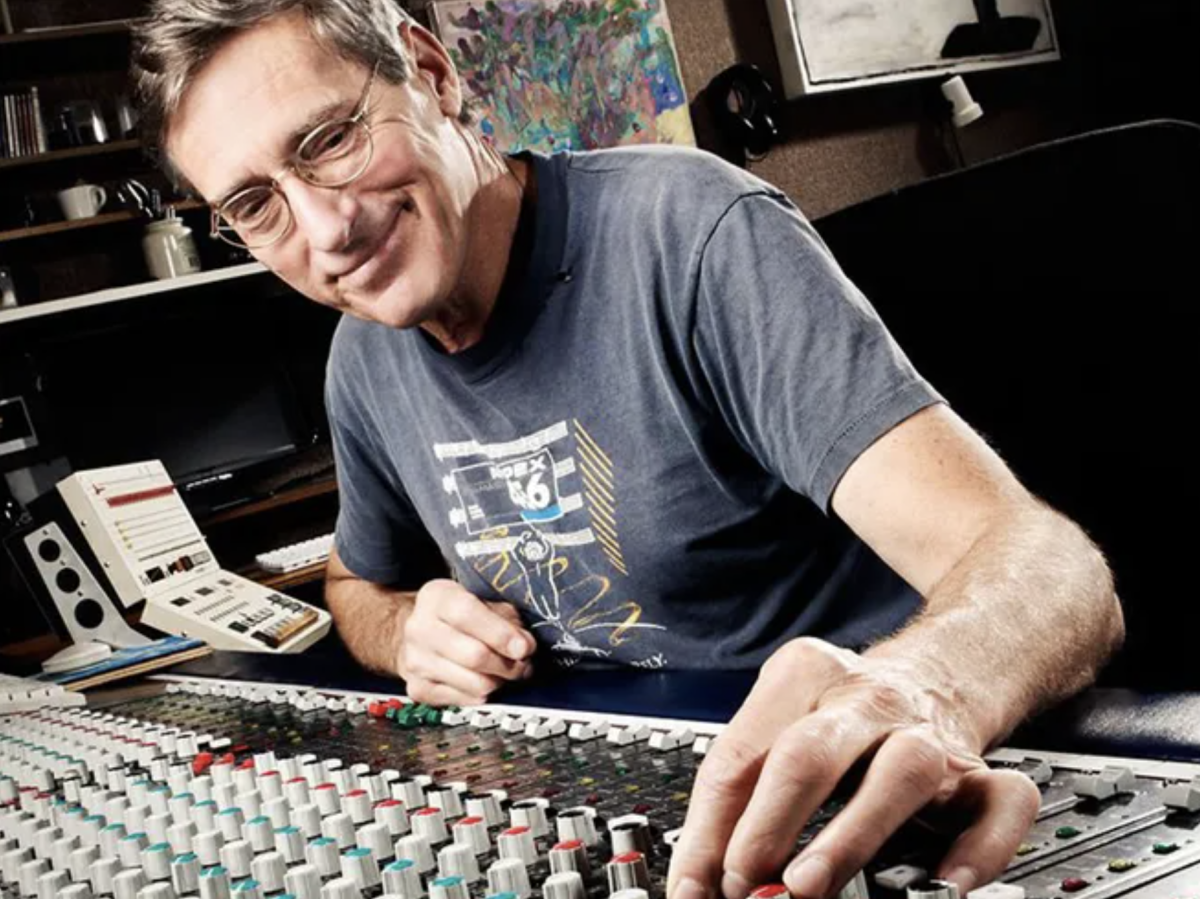
Don Zientara is a local musician and recording engineer. For nearly 50 years, he has been recording musicians and bands. Before that, he worked on exhibits and refurbishing paintings in the army and the National Gallery of Art. His unique perspective has enabled him to both witness the creation and presentation of different kinds of art. I sat down with Don to talk about his life, making art, and helping others make art.
Don has been connected to art all his life, from getting a guitar at 10 years old to tinkering with electronics as well as going to college for painting and printmaking. During his tenure in college, the Vietnam War was raging across the sea. Around 1970, Don was picked in the draft lottery. Luckily, he didn’t have to go overseas.
“Before I actually went in [to the army], I found out that there was a training program in electronics. I researched it and things like that. So I signed up… Supposedly, it was a guaranteed program.”
The program turned out to be full and Don was asked if he’d instead like to take a job at a base in Virginia. He spent the rest of his service touching up and refurbishing paintings at a military base in Alexandria. After leaving the army and getting a job preparing exhibits at the National Gallery of Art in DC, Don gradually began to record musicians by night in his home. By 1979, Don had a whole setup in his Arlington home and started recording larger bands. That year, a record store owner named Skip Groff asked him to record a punk band of teenagers from DC known as the Teen Idles. The past few years had seen the rise of punk rock, a youth-oriented style with lots of aggression and nihilism at first.
“[Around] 1979-80 punk had a bad name for itself, starting fights in clubs… A lot of the punk bands really didn’t know how to play too well, or sing too well or any of that. So they weren’t exactly welcome to a lot of places, whether it’s a studio or club or anything like that. But I found them quite interesting, even though I didn’t totally appreciate the music, I found that it did have something there.”
Although Don wasn’t playing shows with destructive energy, he could sympathize with the punk sentiment: His recording equipment wasn’t top of the line (just like the cheap instruments that punks used), and in some ways, the government had sidetracked his plans. Don was also very resourceful; monetary constraints also led him to build some of his own mixing consoles and equipment to effectively record artists. Back in the 70s and 80s, recording studios were very big deals as their equipment was very expensive. What set Don apart from other studios was his willingness to work with these strange kids. Some studios would berate them for trying to record with such poor equipment or musicianship. Don didn’t have the ego of a “real” studio, and therefore gained nothing from shunning the teens.
From his time at the National Gallery, Don learned to appreciate the value of the presentation of art. A painter can make a beautiful painting, but what good does it do in a dark room? The lights and the right conditions of the room (among other things) are what he means by presentation.
“I dealt with exhibits… One of the weaknesses of a lot of artists, whether you are a visual artist or musician, singer, anything, anytime you need to present something, you have to do it in the right way… There really is an art to doing that.”
Don brought up that he had volunteered at an open mic night at Hard Times Cafe in Alexandria and witnessed artists of many different levels. All of them, of course, were driven to perform the music, but not everyone came off with the same energy.
“I’m sure you’ve seen musicians who just don’t come across well on stage… They’ve learned the songs, and they learn how to play them very well, and they learn how to sing them very well, but they don’t put a lot of thought into how to do it on stage, and it doesn’t take a great deal of effort, but it does take itself.”
In helping record and mix the records of many different bands, Don is putting a frame on the band’s painted canvas of music. He removes the distractions from the art to find the core, to reveal what the artist intended all along.
During the pandemic, Don started putting on outdoor concerts in our neighborhood. In such an isolating time such as the pandemic, these concerts offered a source of connection among neighbors who even before the pandemic may not have known each other. “There were just a few people here that somehow were thinking the same thing, about playing music, and [we] just wanted to do it.”
Don tries to put on a concert or two every summer, and people keep showing up (in fact, I played drums during a recent show). The fact that so many people from the neighborhood came to see the shows demonstrates that people wanted an excuse to go out and do something. If not purely for the music itself, the shows had the effect of bringing people together.
In today’s world, Don knows any one artist won’t bring about change, yet he’s still dedicated to propagating art through the world. “If it’s going to be art, I want to make something beautiful, and past that, I don’t know what’s going to happen.”
In making something beautiful, you try to connect with something deeply human. Don has made art and helped others make art to bring people together and beyond that, he has no say in its effect. It’s a way of connecting people, and maybe that connection changes something. “You know, what you’re doing may be one little speck of what’s changing or pushing it in that direction, but it certainly won’t go in that direction just by your speck, but maybe if there’s 10 other people or 10,000 other people doing that might change it.”
Jeanette Hall • Feb 3, 2026 at 11:22 am
This was a very interesting article and it has encouraged me to ‘get back to being a musician as I have continue with art.
Nice job
Jeanette Hall
KMS
Library Assistant