Welcome back to Motorsport Monthly! From NASCARs Daytona 500, Indycar announcing a race in our nation’s capital and Formula 1’s two weeks of testing, a lot has happened in February.
NASCAR
There were 3 races this past February on the NASCAR schedule. The Clash at Bowman Grey Stadium, the Daytona 500, and the Autotrader 400 at Atlanta. However before we recap the action, there have been some format changes over the offseason. Gone are the playoffs, back is the Chase.
Here are some things that change with the new format. Previously the playoffs consisted of a win and you’re in system. This caused drivers to not be consistent at all and in theory could finish 30th in points (almost last) and win the championship. That is now gone and the playoffs themselves were formatted in an elimination system, which is gone. Drivers will compete for the top 16 spots until the Coke Zero 400 at Daytona in August. Then, those top 16 will advance to the Chase and points will be rearranged to where 1st will start the Chase with a 100 point gap over 16th. That puts 16th nearly 3 races behind in points and with the Chase being only 10 Races, with Homestead Miami being the championship race, there’s a lot of incentive to not being last to start the chase. If you want to find more information on the format change you can find it here: nascar.com.
Every season needs a preseason, an opportunity to get off the rust, and The Clash at Bowman Grey Stadium was that race. The track is a .25 mile short track so cars had to bump and run to pass. On February 4th, Larson led us to green for a 200 lap race and there would be no car on car incident until Bubba Wallace got tagged by Ryan Blaney and spun right around on lap 54. William Byron took the lead until the race was red flagged for weather and rainy conditions. Now, they eventually got under way again using wet weather tires, but that caused a lot of chaos with the race having a clash record 17 cautions. Ryan Preece ended up winning the clash after surging late and holding off Ryan Blaney to take his very first cup series win.
The next two races were at superspeedway tracks, which are tracks where drivers would have to use the draft to gain speed to pass others. This is commonly referred to as pack racing. The first race was the Daytona 500 on February 15th, the most prestigious race in NASCAR. Daytona International Speedway is 2.5 Miles in length with 33 degrees of banking, and is a traditional superspeedway.
The Daytona 500, like many other NASCAR races, is a stage race. Stages divide NASCAR races into three distinct, scheduled stages, aimed at increasing competitive intensity and creating natural breaks for pit stops and TV advertisements. The overall race is split up into thirds, with points being awarded to only the top 10 drivers at the end of each stage. Stages 1 and 2 cover roughly the first half of the race, with the final stage being the longest, concluding with the checkered flag.
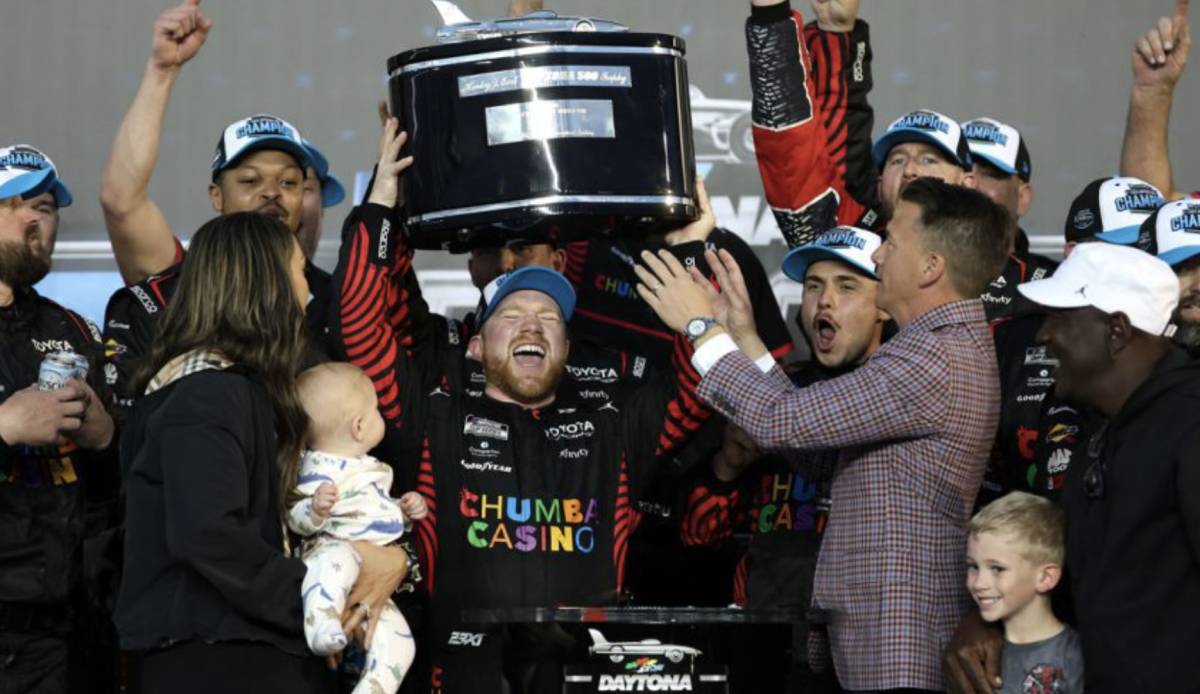
After a race full of incidents that took out many contenders, the finish, too, was action packed. As the last lap started, Carson Hocevar spun to the inside off the lead, which caused everyone to slow down. Riley Herbst found his way to his teammate Tyler Reddick and pushed him to the lead and Reddick was able to take the win after a bad move from Herbst wrecked everyone behind him. Tyler Reddick crossed the finish line first to win the Daytona 500 for 23XI, Michael Jordan’s very own NASCAR team.
The next race was at Echopark Speedway in Atlanta, Georgia on February 22nd, where Tyler Reddick, who qualified first, started the 260 lap race. After numerous small incidents throughout the race, when the race was nearing its end, there was a Big One.
The race still went on under a caution which prompted Overtime. Overtime is often referred to as the green white checkered finish, which extends a race beyond its scheduled distance to ensure a race ending green flag finish if a late caution occurs. It begins with unlimited 2 lap restarts until the leader takes the white flag marking the final lap and in which case any following flag would end the race.
The first overtime began as fast as it ended with Carson Hocevar trying to split the middle of the two leaders, Bubba Wallace and Christopher Bell. This caused Bell to spin to the outside wall in a hard crash. The second overtime restart was the last one, as Bubba Wallace threw a bad block on the back stretch trying to block Carson Hocevar from gaining the lead. He ended up drifting too high and Hocevar split the gap going three wide, however this caused both drivers to lose the momentum, and Tyler Reddick who maintained his line off the bottom, took the lead and was the only car out front. Tyler Reddick came across the finish line to win his second race in a row with a car that had a fender ripped off.
F1
2026, like 2022, and 2017, will be a huge year for the sport of Formula 1. This is because new regulations are being introduced and the changes are immense. The most notable changes are the power unit (engine) changes and alterations to the aerodynamic ability of each car. Each car will be shorter, narrower, and lighter meaning that the speed will still be the same but with each car being smaller, and more maneuverable, more competitive racing should be a positive consequence.
Also, there is a dramatic shift in the split between electric and internal combustion hybrid engines. What was formally an 80-20 split between internal combustion and electric, is now closer to 50-50 according to F1.com. Now, the drivers can recharge their battery more than twice as much as they were able to in prior years to then use their Boost and Overtake modes to attack and defend against other drivers. With many of these regulations designed to level the playing field, it will be interesting to see if McLaren will defend their title or if a different team will find the advantage first.
After testing, how are the top four teams shaking up?
Pre-season testing is a crucial part of the year for the F1 season, and this year it took place on the 11-13th and 18-20th of February. Each team got to put their cars on track and gather data that will help them design strategies with tires, fueling, setups, etc. to use later in the season to try and win races. However, every team had a different approach to the testing stage, some teams just wanted as many laps recorded as possible to get information about how the car is responding to the fast speeds and sustained stretches of driving. Other teams jumped straight into high speed race simulations, testing out race pace for race distance to get a feel for how the car responds to real action.
However, after the second week of testing, where more teams focused on getting their fastest laps down, some surprising results came about. Ferrari put down the fastest lap at the Bahrain Circuit and was the only team to go under 92 seconds for one lap. Also, with a surprising technical development, an upside down rear wing gave them a massive advantage on the straights when the active-aero system was deployed. Mercedes was the second fastest team, just beating out McLaren with Kimi Antonelli throwing down a lap in the low 1:32.8s. Naturally, Max Verstappen was the fastest of the Red Bull pair, but still slower than Ferrari, Mercedes, and McLaren. Mercedes put in the most laps at 432 across the three days but had an engine issue that forced Antonelli to stop on track during a test. Reliability is a key factor that determines how successful a team can be. Obviously it’s not good to have reliability issues, but the teams can fix their issues and find ways to prevent them from happening again in the testing window.
McLaren hasn’t wowed anybody quite yet, but they put in the second most laps in the second testing week and are still the defending champions. With Ferrari putting down the fastest lap, and their new technical innovation, it is easy to brand them the favorites for the 2026 season. Although they’ve suffered many strategic and driver errors in seasons past, this is the best they’ve looked since 2022, where they were championship leaders for a time, and, the last time there were new regulations.
NTT Indycar
The first race of the season began last weekend at the Grand Prix of St. Petersburg on March 1st. Drivers are viewing this season quite differently from last year. Many said that Palou was catchable before the beginning of last year, but after Palou dominated last season winning over half the races, drivers are saying they need to be perfect to beat him.
President J. Douglas Boles says he expects this year to be even greater than last year’s. He said, “The addition of new events at Phoenix, Arlington, Markham and Washington D.C., combined with integration around this summer’s FIFA World Cup 2026™ on FOX, will provide even greater opportunity to showcase the ultra-competitive, wheel-to-wheel racing and dynamic driver personalities that the NTT INDYCAR SERIES is known for” according to Forbes.com.
Last month Indycar also announced that it will be holding a race in Washington DC from August 21-23 to celebrate the USA’s 250th Birthday. It is named the Freedom 250, and while a track map is not yet known, it will be going past the Lincoln Memorial and Washington Monument. Do not expect this extra race to remain on the Indycar calendar past this season as it is viewed as a special one off event to commemorate American independence and showcase America’s capital city.
You can watch each category this weekend. NASCAR will be racing from Las Vegas at 4PM EST on FS1 on Sunday, March 15th. Indycar Racing from Arlington TX at 12:30 EST on FOX also on Sunday, March 15th. F1’s Chinese Grand Prix will be at 3AM EST on Sunday the 15th on Apple TV.