


Because people are generally limited in their free time, an artist needs not to burden themself with devotion to learning the “rules” or from the “masters” of a certain field. Of course, this statement still allows for appreciation of great and prominent artists, it is merely a reminder that one is not beholden to them; for instance, if an artist wanted to create a period piece set in France in the 60s, they might borrow techniques from the French New Wave to evoke a feeling more associated with that time and place. While the diligent study and inspiration taken from the generally accepted greats might bring an artist towards some semblance of “greatness”, the study and acceptance of one’s own passions, no matter how unpopular or obscure will more likely bring an artist towards a semblance of “originality” and the finding of one’s own artistic “voice”. For the sake of argument, I would like to focus on what I believe to be the more interesting of the two: the “originals”.
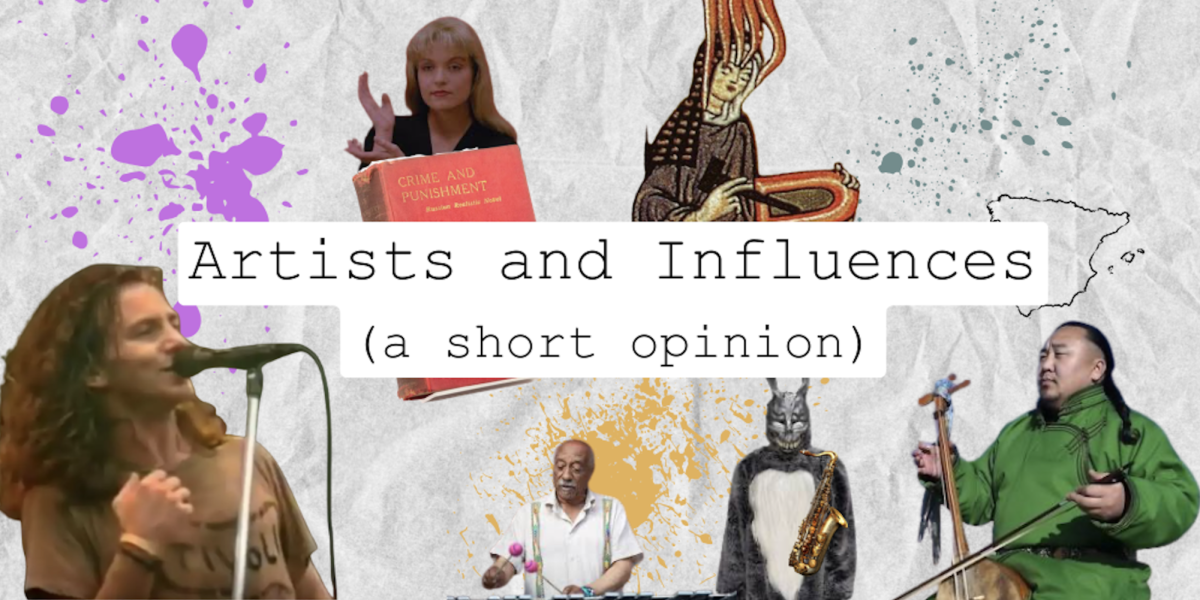
Despite increasing fragmentation due to the internet, many forms of media still have works that amass a large audience, be it due to the backing of a major film studio or record label. Because these pieces of media are so widely consumed, they act as trend-setters and have the ability to popularize certain stylistic elements. As they grow in popularity and exposure, people begin to grow tired of the omnipresence of said work, no matter how initially potent they might be. An example of this could be seen in the early vocal style of Eddie Vedder from Pearl Jam. Despite originally being something novel and a contrast from the shrill voices of 80s Hair Metal, the “yarl”, as it came to be known, turned into somewhat of a joke from mass exposure not just of Pearl Jam, but those who tried to copy them and achieve similar success (Nickelback, Creed, etc). I state all this, because in order to find one’s own voice and express originality, they must distance themselves from the most surface level similarities and clichés found in the zeitgeist.
When I mention originality, I don’t refer to absolute originality, the kind referring to something that has never been successfully attempted before, but I refer to an illusion of something new, a collection of far-flung influences that an artist synthesizes to provide a breath of fresh air into the stale room of the status quo. The movie Donnie Darko isn’t absolutely original, no matter how incomprehensible it may at times seem. It pulls its backdrop and songs from the American pop culture of the 80s, while combining plot elements that on the surface seem as obscure as a David Lynch movie from the 90s or 00s. From this synthesis of sources, writer/director Richard Kelly created something that feels both familiar and alien yet also completely individual.
Now someone reading might remark, “you can still learn the rules and break them, just look at Charles Ives!” While I do believe that is true, one must also take into account the limited time each and every one of us is slowly spending every day. In a perfect world with unlimited time, I would readily encourage the study and (attempted) appreciation of all the Da Vincis, Tolkiens and Morrisons of history, but our time is limited and sometimes we are simply drawn to less universally lauded figures. Some artists have to spend half their time toiling at day jobs while others receive commissions and spend their days in studios; if a member of the former group had an epiphany and began to work on an artwork with what little time they had, how would they feel if they were forced to first learn the academic and “right” way to do things? In my opinion, such preoccupations with proper craft would almost assuredly obscure their vision. Although quality in general is important, the emotional and intellectual core of a work is, in my opinion, more important to fulfilling an artist’s intentions with a work of art, but I digress.
To recapitulate, I am merely putting forth the idea that an artist need not be beholden to the study of or inspiration from widely regarded masters. With their limited time they are free to consume and cobble together their own art from disparate sources that excite them, and don’t merely echo a stagnant zeitgeist; this method will almost by definition produce a more disparate, “original” work of art, regardless of perceived quality (which is subjective). I must restate that this opinion is simply a result of the world presenting ever-imperfect conditions and if faced with both passion and unlimited resources, an artist should strive to reconcile both this synthesis of disparate sources and of accepted masters.