


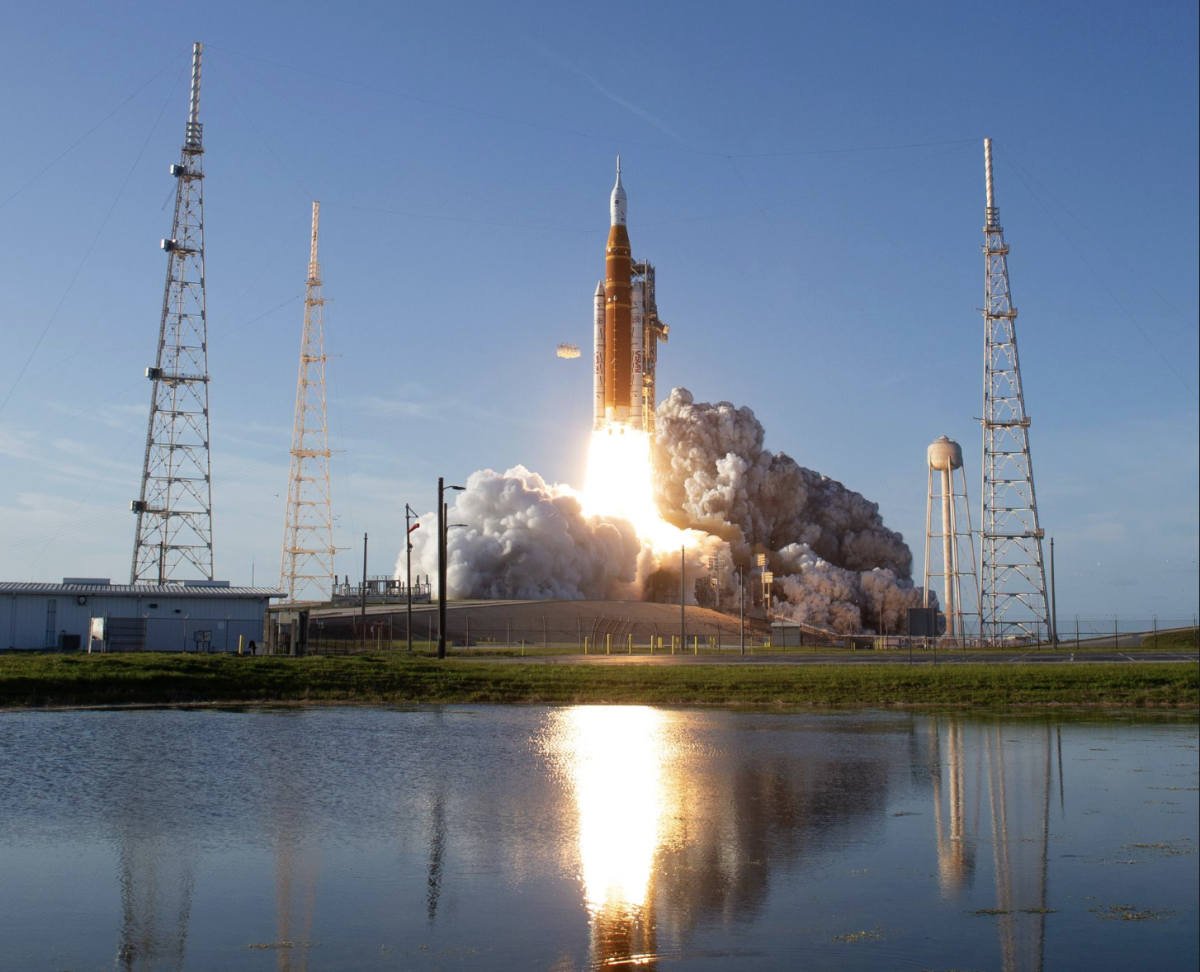
Around the world, millions watched as the most ambitious missions of the twenty-first century unfolded before their eyes. On April 1, 2026, Artemis II lifted off from NASA’s Kennedy Space Center, bringing its crew on a historic flight around the Moon, the first mission of its kind since Apollo 17 sent the last humans to the lunar surface in 1972.
Their ten-day adventure was over fifty years in the making, and it has captivated countless people back on Earth. But in case you somehow missed it, here’s a breakdown of the Artemis Program and Artemis II’s journey.
What is the Artemis Program?
The Artemis Program was created by NASA in order to prepare humans to return to the moon and beyond. Through five separate missions spanning past and upcoming years, they plan to test new technology that could lead to increased space exploration and even the commercialization of the moon and other planets.
Excluding Artemis II, for now, here’s a short summary of every mission in the Artemis Program according to NASA.
Artemis I: Launched in 2022 to test the Space Launch System and the Orion Spacecraft on an uncrewed mission around the moon.
Artemis III: Planned launch for 2027 in order to test the commercial landers from SpaceX and Blue Origin.
Artemis IV: Planned launch in early 2028 using commercial landers to descend onto the surface of the Moon for the first time in the program.
Artemis V: Planned launch for late 2028 for a second Moon landing trial. If successful, it would usher in more frequent visits to the lunar surface.
Important Technology
Before talking about Artemis II, you need to know about the two biggest technological developments NASA has made in order for the Artemis Program to be possible: the Space Launch System and the Orion Spacecraft.
The SLS is the newest rocket design for all future space missions. According to NASA, the SLS is equipped with four engines and two rocket boosters, which allow it to generate a maximum thrust of 8.8 million lbs after liftoff, helping it reach a maximum speed of 22,670 mph. The sheer force generated by the SLS allows it to reach the Moon in a single shot, which is vital for future missions.
The Orion spacecraft allows astronauts to return to Earth after their missions are complete. A couple of hours after takeoff, the Orion Spacecraft detaches from the SLS to orbit in space. Notably, this is where the Artemis II crew spends their entire journey.
During re-entry into Earth’s atmosphere, the pod will fall down at 25,000 mph while facing around 5000 degrees Fahrenheit. To withstand these extreme handling conditions, the base of the Orion Spacecraft is protected by a heat shield made of Avcoat, a heat-absorbing material, according to NASA. This allows the Orion Spacecraft to splash down safely on Earth.
What is the Artemis II Mission?
Artemis II was designed to be another test for the Space Launch System and Orion Spacecraft in space travel, but more importantly, it was going to be the Artemis Program’s first crewed lunar flyby. After the success of Artemis I, NASA greenlit the program’s continuation and began preparing for the historic flight.
The first step for Artemis II would be choosing its crew. In 2023, after a lengthy selection process, NASA officially announced Reid Wiseman, Victor Glover, Christina Koch, and Jeremy Hansen as the four astronauts they would be sending to space aboard Artemis II.
Despite plans for takeoff in late 2025, Artemis II would face several delays in the coming months, mostly due to mechanical issues such as heat-shield concerns, hydrogen and helium leaks, and even impending weather. These setbacks would eventually push the launch to April of 2026, where the crew would finally make their ascent into space as millions watched from below.
While on their way to the Moon, Artemis II was also tasked with monitoring life support systems, deep-space operating systems, and their own physiological health. After takeoff, it would take the crew five days to reach the Moon, where they would orbit it, and return home to Earth.
In total, Artemis II traveled 248,655 miles from Earth, making it the farthest human spaceflight ever, according to NASA. After their journey around the Moon, the astronauts finally re-entered Earth’s atmosphere on April 10, 2026, splashing down into the Pacific Ocean, where they were recovered and returned to life on Earth.
The Significance of Artemis II
The success of Artemis II will be remembered as one of the most daring and significant achievements in modern human history. It ushers in a new era, as humanity prepares to journey even deeper into space in the years ahead. Artemis II serves as the biggest stepping stone for the future, but perhaps its greatest impact will be on the imaginations of millions around the world. This mission has inspired the next generation of astronauts waiting to explore the stars. Artemis II offers hope for the future and reminds us that nothing is impossible.