


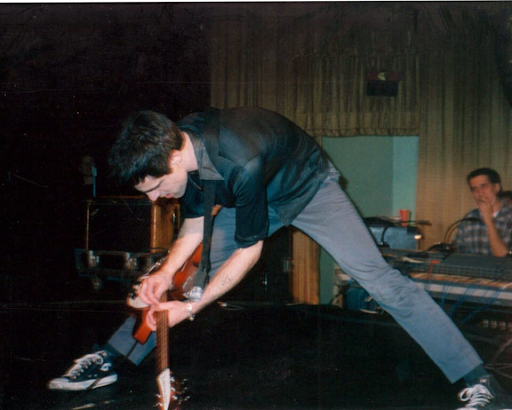
Guy Picciotto has been the frontman for Rites of Spring (the “first emo band”) and 1/4th of the singular live band that was Fugazi. Today, he lives in Brooklyn, occasionally producing records for the likes of Xylouris White, Blonde Redhead, etc. He was kind enough to answer some questions I had over email. Enjoy!
1) Fugazi songs, like Version and Floating Boy, feature a clarinet. What is your personal history with the clarinet and do you still play it?
My personal history with the clarinet is actually pretty random. It is not an instrument I grew up playing or anything like that. In fact I don’t think I ever really gave the clarinet much thought at all as a young person. It didn’t really feature in any of the rock and roll bands I grew up with and I didn’t know much about classical music or jazz at that stage. It vaguely seemed to me to be associated with Benny Goodman and the phrase “ the old licorice stick” but beyond that I was clueless.
The first time I was ever actually personally affected by the clarinet was when I saw Patti Smith play at the Warner Theater in 1979 when I was around 13 years old. At some point during her show she pulled out a clarinet and kind of improvised some chaotic runs over the band and I was very impressed by her just going for it. Years later around 1992 when I was in Fugazi I went to visit my friend Jerry Busher who was working in a music shop near Dupont Circle. He mentioned that the shop has just picked up a used clarinet and on a whim I asked to see it. Jerry offered me a ridiculous friendly discount on it so I just impulsively bought it along with some reeds and a fingering chart.
At home I started fooling around with it in a very amateurish way and enjoyed it but I never really committed myself to trying to learn the instrument with any great seriousness. That said, it was fun to mess around with and I did play it in a project band we did around that time called Savant Garde which was a jazz-ish instrumental band that played just one or two very small shows. Later, I started bringing the clarinet to Fugazi demo sessions and practices and I ended up using it in such songs as “Version” and “Lusty Scripps” and “Floating Boy”. Because of my limitations I used it more as a sound effect or a texture but there was some note playing as well as improvisation going on at the same time. It had a cool alien sound that I really enjoyed and I did play it live whenever we played “Version”.
I was recently cleaning my studio and I found that clarinet and it was looking good! I put a reed on it and fooled around with it for an afternoon and I am happy to report that I can still hit the notes!
2) From Carly, my bandmate: Who were your guitar inspirations and what effect did they have on your style?
When I was first starting out playing guitar I had musicians that I looked up to but they were more aspirational as I had no skills to try to emulate any of them. I would listen to music and it felt like a code that I couldn’t process or pull apart to figure out what was actually being played. Once I started to play with other people when I was between 14 – 16, I started getting a lot of information by osmosis from other kids in the early DC punk scene who were in bands that I looked up to – like Mike Hampton and Eddie Janey from the Faith. Once I started collaborating with Brendan and Mike Fellows in our early bands I also picked up a ton of stuff from them as well.
Now there are a lot of musicians who I consider guitar inspirations and I have more of an understanding of what it is that they are doing even if I still can’t always emulate it. I would consider people like Johnny Marr, Derek Bailey, James Honeyman-Scott and Tom Verlaine guitar players who I deeply love and study though I am not anywhere in the league of any of them.
A lot of my style actually came together when I was still really ignorant in a technical sense but I credit extensive touring with teaching me how to express myself better and find my own sound. Playing at the loud volumes Fugazi used to play at live is a different style of playing than I do when I am at home where I rarely play through an amplifier. At home I usually play acoustic guitars or unplugged electrics which leads me to play differently, too. One thing that has always been constant is that much of my playing is centered around open chords or invented chords. I really like hollow body guitars for the resonance and the aural space they create.
3) Following up on Carly’s question: I really enjoy the balance between immediacy and penmanship in your lyrics; How did you develop this style and who inspired it?
I don’t really know how my lyric writing came together as I am not a person who tends to write very much outside of music. Like I don’t write poetry or fiction or whatever. But I like the assignment-vibe of having a song that needs words and then trying to see what comes out. I used to just walk around for hours with songs in my head seeing what words came to fill the spaces. It is rarely an intentional process for me – it’s more like pulling a thread on a sweater.
In some ways I feel like my style has changed a lot depending on what band I am in. I don’t think of Rites of Spring, Happy Go Licky, or Fugazi as necessarily being tied together even though they came from the same person. Each of them were sort of bound by the time and the context of what each band was doing and where my head was at that time. So I don’t feel like there is a style at work – just what came out of the necessity of the moment and the process of writing songs. When I don’t have a band or a song to work on I never write.
That said I do love lyrics so I have spent a lot of time paying attention to them. I love Bob Dylan, Tom Verlaine, Darby Crash, Ray Davies, Jason Molina, HR etc etc.
4) Describe your transition from a performer (Happy Go Licky, Rites of Spring, and bands that don’t necessarily involve Brendan Canty, Eddie Janney, or Michael Fellows) to a producer (Xylouris White, Casual Dots, etc.) and what do you enjoy from both?
Engineering and producing was really a by-product of being in Fugazi. Once Fugazi started getting a bit of money together from touring, we invested in a bunch of recording equipment so that we could start making demos of songs and recordings of our rehearsals. We got a bunch of mics, a mixing desk, monitors and an 8 track reel to reel tape recorder. For a long time the gear was in the basement of the group house I was living in so I just started offering to record other bands in our scene who didn’t necessarily have the funds to go to a proper studio. Gradually I sort of taught myself how to run the gear and get sounds etc.
I still don’t consider myself as very technical engineer in the sense that I never studied it and I don’t really have an understanding of the science of sound. What I do have is good focus and I know how to work with musicians. When Fugazi stopped working regularly, a large space opened up in my life and I had a lot more time to work with other bands that were interested in working with me. I would never say that I rate production work above being live musician because they are just totally different experiences but what I do love about producing is the chance to integrate your sensibility with other sensibilities. When I worked with bands like Xylouris White or Blonde Redhead, I felt completely immersed in the process and it was like getting to be an auxiliary member of bands that I loved and deeply appreciated. I like that production can contain so many things: engineering, mixing, arranging, counseling, experimenting. Ultimately, it is a lot like being in a band – you have to be open to spontaneity and you have to be open in your listening.
5) What advice do you have to young artists who are already out there making things?
I don’t really have any advice to offer except the crucial ones of being kind to yourself and to always try to make your own road. It is actually the hardest thing to do sometimes but trusting your own voice and your own perspective instead of chasing something exterior to yourself is always the right move.
6) Penultimate question: please recommend one record that you cherish dearly, but to the uninitiated would seem uncharacteristic of you.
I have no idea what people think I would or would not like but a record that has meant a lot to me since childhood is Roger Miller’s “Words and Music”.
A more recent discovery that really has left a mark on me is Connie Converse’s “How Sad, How Lovely”. I also really love “Ghost Tropic” by Songs: Ohia.
7) Is the torch ours to return?
I would say yes